
Basics of Apparel Plant and Sewing Machines Layout

 A good factory layout is directly associated with good workflow, right from material receiving till the finished goods go out of the factory. Whatever type of plant layout a firm develops, it should be designed to optimize quality, throughput time, and flexibility.

Experts differ in views on how and what constitutes a good layout. It is never easy to rate one layout over the other when both achieve the desired results. But at times, little changes bring wonders.

Suresh Dureja, in this article, defines the basic considerations while conceptualizing and designing a factory layout.

Plant layout is the spatial arrangement and configuration of departments, work stations, machinery and equipment used in the conversion process. Layout of an apparel production plant directs the flow of materials and work-in-process from start till its completion and integrates material handling and equipment.

An efficient layout has the flexibility to be changed to meet requirements of the product line, delivery schedules, and anticipated volume. Safety is a major consideration in plant layout. Fire and safety codes, emergency and accessible exits, open traffic areas, etc. must all be a part of layout plans.

The following factors should be taken into consideration while planning a layout:

• Minimization of manufacturing cost,

• Feeding the materials and parts at highest possible speed and in one direction without any backtracking or overlapping flow of products,

• Minimization of work transfer among the processes from acceptance of raw materials till delivery of finished product with properly defined spaces for each process, and

• Provision of future expansion plans.

The layout planning should be done based on factory site selection and arrangement of buildings and machines.

Layout of the Plant

Layout of the plant is decided based on process sequence, building structure, shop floor transportation, type of layout (product or process based or a combination of both) and arrangement of machines. The aim of every layout is to maximize utilization of available space in order to speed up the material flow. Highly specialized machines and small parts assembly may be configured with a line arrangement for final assembly.

Factors to be considered for designing an effective layout include number of workers both male and female, number of machines (size, weight by models), entrance, exit and passages (size, width, position, number of each of them) for production as well as administrative wing, change room, lunch room, lavatories, medical emergency room and provision for those governed by local laws. Utilities like boiler, air compressor, vacuum pumps, generator, electric panel, air conditioning machine, underground water storage tanks for boiler and washing machines, water softening plant, waste water recycling plant, drainage system are also equally important.

General Steps for Making a Plant Layout

Make a scaled drawing of factory/shop floor

Make models of machines/equipments

Draw immovable facilities/equipments
• Entrances, exits/stairs
• Washrooms, corridors
• Pillars, partitions
• Air conditioning ducts, steam, air and vacuum lines
• Power outlets, electrical lines for feed to machines,
electrical panels

Arrange the main flow process in a straight line regardless
of available space

Arrange the main flow process in the available space

If it is necessary to change the direction of main flow process change it for worker who is in charge of an iron or a special purpose machine

Arrange the additional divisions in the remaining space

Make a final drawing based on completed machine layout

Other factors that need attention before laying out the factory plan include ceiling height (3-3.5 metres from floor), lighting (large windows of 2 or 3 stages) and illuminance levels (600 Lux for production and 800 Lux for inspection areas) besides ventilation. Also, the workplace should have sufficient number of men’s and women’s toilets and drinking water outlets in the vicinity.
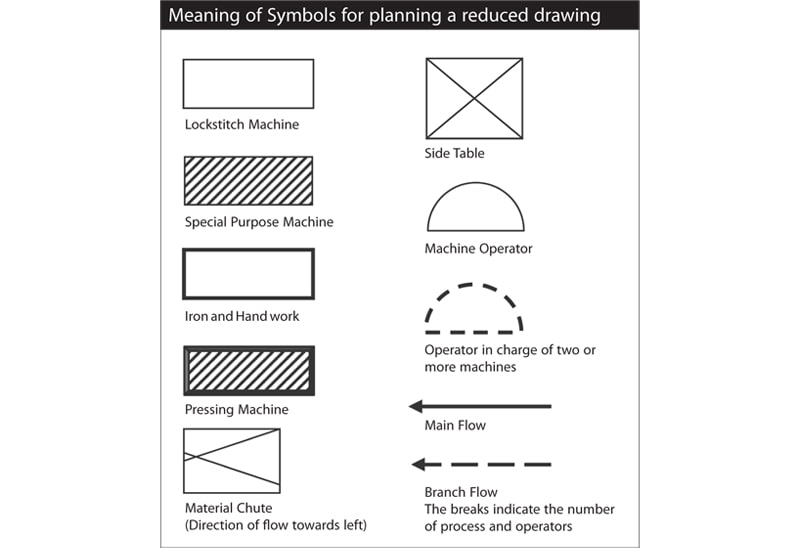
Factors influENcing Machine layout

Comments

Popular posts from this blog

পেশা হিসেবে মার্চেন্ডাইজিং : প্রেক্ষিত বাংলাদেশ ।

 পেশা হিসেবে মার্চেন্ডাইজিং বর্তমানে বাংলাদেশের বৈদেশিক মুদ্রার বড় একটি অংশ আসে তৈরী পোশাক শিল্প থেকে । আর তাই চাকুরী ক্ষেত্রে ক্রমান্বয়ে বাড়ছে দক্ষ  মার্চেন্ডাইজারদের চাহিদা । প্রকৃত পক্ষে মার্চেন্ডাইজাররাই পুরো ব্যবসা দেখভাল করে বললে অত্যুক্তি হবে না । কারণ সিদ্ধান্ত নেয়ার কাজগুলো তাঁদেরকেই করতে হয় , আর বিনিয়োগ করেন মালিকগণ ।  বাংলাদেশের প্রেক্ষাপটে শিক্ষার সাথে পেশার  কোন ও সমন্বয় নেই । যেখানে বিশ্বের সমস্ত উন্নত দেশেসমূহে প্রচলিত শিক্ষার সাথে তাদের দেশের শিল্পকারখানাগুলোর একটা সমন্বয় আছে । যাতে করে ছেলে মেয়েরা পড়াশোনা শেষ করেই কর্মক্ষেত্রে প্রবেশ করতে পারে,  আমাদের মতো   বেকারত্বের বোঝা না বইয়ে ।  মহামারী কোভিড-১৯ এর পরে বাংলাদেশের পোশাক শিল্প আবারো ঘুরে দাঁড়ানোর চেষ্টা করতেছে সকল প্রতিকূলতা ডিঙিয়ে । আর সেই ক্ষেত্রে বেড়েছে দক্ষ মার্চেন্ডাইজারদের। এই শিল্পে একমাত্র দক্ষরাই টিকে থাকতে পারে  দীর্ঘ সময় ধরে। সাধারণত স্নাতক শেষ করেই এই পেশাতে প্রবেশ করা যায় । কিন্তু এই পেশায় খুব ভালো করতে হলে বিজিএমইয়ে পরিচালতি বিইউএফটি তে ( বিইউএফটি এর ওয়েব স...

Overall Efficiency Vs On-Standard Efficiency

  You may know the definition of Efficiency. You may know how to calculate the efficiency of a production line or an individual sewing operator. But do you know - What is On-standard efficiency and overall efficiency? How to calculate on-standard efficiency and overall efficiency? What are the differences between these two efficiency terms? These are the new terms to many industrial engineers and production people. If these terms are also new to you, read this post. Workers performance and production line performance is measured in efficiency. Efficiency is calculated using the formula that we have discussed in  an earlier post  with an example. Efficiency Calculation formula   Efficiency (%) = (Total minutes produced / Total minutes attended at work)*100  When the On-Standard Efficiency and Overall Efficiency are measured In a normal workday, operators spend their total attended time following categories doing standard work doing off-standard work (doing a...

COSTING FOR A SPINNING MILL

      INTRODUCTION: It is better to review the basics concepts, costing methods and techniques and elements of costing before we work out a costing for a spinning mill. Cost accounting is a system of determining the costs of products or services. It has primarily developed to meet the needs of management. It provides detailed cost information to various levels of management for efficient performance of their functions. Financial accounting provides information about profit , loss, cost etc., of the collective activities of the business as a whole. It does not give the data regarding costs by departments, products, processes and sales territories etc. Financial accounting does not fully analyse the losses due to idle time, idle plant capacity, inefficient labour, sub-standard materials, etc. Cost accounting is not restricted to past. It is concerned with the ascertainment of past, present and expected future costs of products manufactured or services supplied. Cost account...